Customs-Safe Bulk Phone Screen Shipping to Latin America 丨ARI
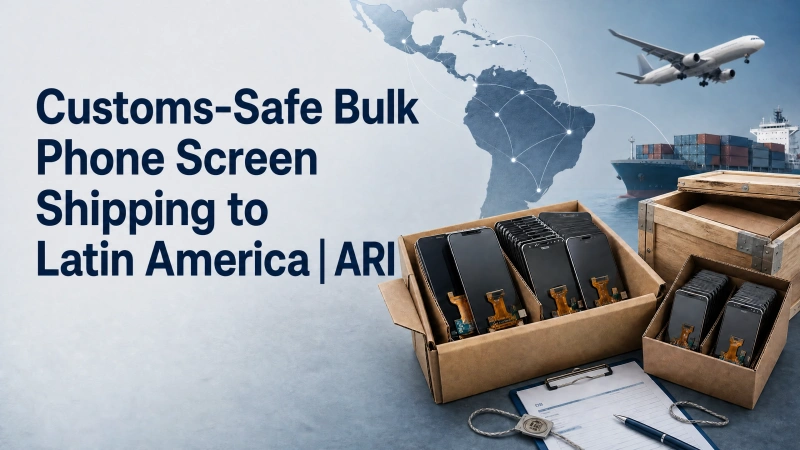
For mobile-phone repair chains, parts wholesalers, electronics distributors, and cross-border purchasing teams in Latin America, importing bulk phone screens, batteries, and other repair components involves more than finding a competitive product price. The shipment must also clear customs smoothly, avoid unnecessary intellectual-property confusion, move through a suitable logistics route, and arrive with predictable costs and delivery responsibilities.
At major ports and logistics gateways such as Lima in Peru, Guayaquil in Ecuador, and San Antonio in Chile, importers may need to manage customs declarations, intellectual-property reviews, battery-transport requirements, local duties, and last-mile delivery at the same time. A small manufacturer logo on a flex cable, an unauthorized mark on a component, or a retail-style box can create additional inspection questions. For a large shipment, the consequences may extend beyond one freight bill to include delayed customer orders, disrupted repair operations, and working-capital pressure.
For this reason, customs-safe phone parts shipping should not be understood as an attempt to avoid regulation. It should be based on accurate declarations, legitimate product presentation, compliant packaging, and traceable logistics. ARI has developed a coordinated packaging and shipping approach for wholesale phone screens and related repair parts to help customers identify avoidable issues before dispatch and select a more practical route for their market.
1. Why Are Bulk Phone Parts More Likely to Encounter Customs Friction?
Phone screens are highly standardized products with a large number of model variations and strong associations with well-known brands. Two screens may look similar while using different flex-cable designs, control components, or compatibility specifications. During a customs or intellectual-property inspection, information on a retail box, label, flex cable, chip, or product document may affect how the shipment is understood and reviewed.
Common issues include unauthorized brand elements on packaging; brand-related markings on flex cables or IC components; commercial invoices whose descriptions, quantities, or declared values do not match the physical goods; mixed-model shipments without a clear packing list; missing battery-related information; and shipping routes selected only by price rather than by destination-country requirements and final-delivery capabilities.
These issues do not automatically mean that cargo will be detained or seized. They can, however, increase the possibility of additional questions, inspection, or delay. A more responsible approach is to review the product, packaging, documents, and shipping route before dispatch rather than attempting to resolve every issue after the cargo reaches the destination port.
| Risk Area | Common Trigger | More Practical Approach |
| Outer packaging | Retail boxes, prominent brand graphics, or unauthorized promotional language | Use neutral packaging and review labels before dispatch |
| Flex cables and components | Sensitive brand marks or unclear model information | Apply lawful masking, replacement, or neutral presentation where appropriate |
| Commercial documents | Product description, quantity, or value does not match the actual cargo | Prepare documents based on the real shipment |
| SKU management | Mixed models or unclear carton contents | Match SKUs, models, quantities, and carton numbers in the packing list |
| Battery shipments | Insufficient information or packaging that does not meet carrier requirements | Confirm battery classification, documents, and carrier acceptance in advance |
| Logistics route | Choosing only by freight price | Compare route, timing, volume, destination, and total landed cost |
2. 100% Neutral Packaging: Reducing Unnecessary Intellectual-Property Confusion
ARI provides 100% neutral packaging for wholesale bulk phone screens and batteries. In practical terms, this means that outer cartons, inner boxes, labels, and promotional inserts do not actively use unauthorized brand elements or create the impression that compatible products are official, original-brand products. Packaging can still be customized for SKU management, warehouse operations, and transport requirements, but the customization should remain accurate, clear, and lawful.
For product categories associated with high-risk brands, including iPhone- or Xiaomi-compatible products, packaging requires particular care. Importers should distinguish between accurately describing compatibility with a model and presenting a product as an unauthorized original or official product. A compliant description should identify the product category, compatible model, function, and specifications accurately. It should not suggest an official manufacturer relationship that cannot be demonstrated.
2.1 Neutral Outer Cartons and Inner Packaging
Neutral packaging can reduce unnecessary brand-related confusion during transport and inspection. Depending on the order and destination, ARI can arrange unbranded outer cartons, neutral inner boxes, and clear model references while preserving the information needed for warehouse receiving, such as model, SKU, quantity, carton number, and batch reference.
Neutral packaging does not conceal the shipment or replace a legal declaration. The commercial invoice, packing list, shipping label, and other documents must still describe the actual cargo truthfully. The value of neutral presentation is to avoid misleading retail-style branding and make it easier for customs personnel to understand the goods through consistent, accurate information.
2.2 Handling Flex-Cable, Flexible-Circuit, and IC Markings
Flex cables and control components are small, but their markings may attract attention during an inspection. Based on the customer’s destination market and product profile, ARI can discuss compliant presentation options such as neutral labels, removing unnecessary promotional presentation, or using clear compatible-model references.
Any masking, replacement, or neutralization must be carried out within applicable laws and must not remove legally required safety information, certification marks, serial numbers, or traceability data. If a product involves trademark, patent, authorization, certification, or origin questions, importers should obtain appropriate legal and customs advice before dispatch.
2.3 Clear Product Descriptions Are Better Than Vague Descriptions
“Neutral” does not mean “unclear.” For an importer, useful packaging normally has three characteristics: it avoids unauthorized brand promotion; it identifies the product category and compatible model clearly; and it corresponds with the invoice, packing list, and purchase order.
For example, packaging may describe a product as a “mobile phone display assembly” or a “compatible screen assembly for [model]” when that description accurately reflects the product. It should not use terms such as “original” or “officially authorized” unless the importer can substantiate those claims. Clear descriptions improve both warehouse control and customs understanding.
3. Multi-Channel Shipping: From International Express to LatAm DDP Lines
Different customers have different order volumes, delivery deadlines, budgets, and destination requirements. No single shipping method is ideal for every scenario. ARI evaluates international express services, Miami forwarding, Panama Colón Free Zone transit, sea freight, and selected Latin American DDP routes according to cargo weight, value, urgency, destination, and the customer’s need for cost visibility.
3.1 International Air Express: For Urgent, Small, or High-Value Orders
DHL, UPS, and FedEx services are often suitable for urgent replenishment, samples, small quantities of high-value repair parts, or orders that need relatively fast delivery to cities such as Santiago or Bogotá. Based on the route and shipment profile, some urgent shipments may target a 3–5 business-day transit window. Actual timing can be affected by flight schedules, customs inspection, public holidays, address coverage, and local delivery conditions, so the final estimate should be confirmed for each order.
The main advantages of express shipping are speed, standardized handling, and relatively complete tracking. The limitations may include higher unit freight costs and additional restrictions for batteries, magnetic components, or other regulated cargo. If screens and batteries are included in the same order, the importer should confirm carrier acceptance and document requirements before booking.
3.2 Miami Forwarding and Sea Freight: For Heavy or Recurring Replenishment
When an order grows from a small express shipment into a consolidated, palletized, or recurring wholesale order, using high-cost express services for every shipment may put pressure on margins. Miami forwarding and sea-freight transit can provide a more cost-conscious alternative for planned volume.
Cargo may be routed through Miami hubs or regional logistics points such as the Panama Colón Free Zone, followed by local consolidation, distribution, and final delivery. The value of this structure is not simply the existence of a transit point. Regional consolidation can help distribute freight costs across a larger shipment and support more predictable replenishment planning.
For customers serving Peru, Ecuador, Colombia, Chile, or Caribbean markets, the route should be assessed together with the actual destination, importer of record, shipment frequency, warehouse capacity, transit time, and responsibility for final customs clearance and delivery.
3.3 Specialized LatAm DDP Lines: More Predictable Door-to-Door Planning
For selected markets such as Peru and Colombia, ARI can evaluate specialized DDP (Delivered Duty Paid) options designed around door-to-door delivery. Unlike a service that ends at the destination port or airport, a DDP route may coordinate international transport, customs clearance, applicable duties and taxes, and local delivery so that the importer has a clearer view of the expected delivered cost.
DDP does not mean that one identical solution applies to every country, product, address, or importer. Feasibility depends on destination-country rules, product category, importer profile, customs requirements, tax treatment, city coverage, and the carrier’s clearance capabilities. Before confirming a DDP quotation, importers should ask the provider to clarify whether the price includes all applicable duties and taxes, destination charges, remote-area delivery, inspection-related costs, storage, re-delivery, and return handling.
| Shipping Channel | Best Suited For | Main Advantage | Items to Confirm in Advance |
| DHL / UPS / FedEx Express | Samples, urgent replenishment, small high-value orders | Faster movement and detailed tracking | Customs process, remote-area charges, battery restrictions |
| Miami forwarding | Medium-volume or multi-batch orders | Regional consolidation and flexible handling | Transit time, storage, and responsibility for onward delivery |
| Panama Colón Free Zone transit | Distribution across multiple Caribbean or South American markets | Regional hub and consolidation options | Final importer, destination clearance, and delivery arrangements |
| Sea freight LCL or FCL | Heavy cargo and planned recurring orders | Potentially better unit economics for larger volume | Sailing schedule, port charges, inspection, and destination handling |
| LatAm DDP line | Orders that prioritize door-to-door simplicity | Coordinated clearance, duties, and local delivery | Country coverage, tax basis, surcharges, and service scope |
4. What Should Importers Check When Bringing Phone Parts into Peru?
Importers planning to bring phone screens and other phone parts into Peru can benefit from a four-way review before dispatch: order, packaging, documents, and route. First, confirm the actual product name, compatible model, quantity, unit value, and total value. Next, check that the outer carton, inner box, and component markings correspond to the intended packaging requirements. Then, prepare commercial invoices, packing lists, and transport documents that match the shipment. Finally, select express, sea freight, regional transit, or DDP according to the cargo volume and delivery objective.
Importers should avoid the practice of shipping first and attempting to complete the documentation later. For a first order, a new model, or any shipment that includes batteries, sharing the product list and packaging details in advance can help identify potential marking, transport, or customs questions. If the cargo involves trademark authorization, certification, or other special requirements, those issues should be reviewed before the order is dispatched.
ARI can help customers organize a packaging and logistics proposal based on the destination country, product list, order size, and delivery requirements. The importer, customs broker, and logistics provider must still confirm the final requirements under applicable local rules. No supplier should promise to eliminate every customs risk, because inspections, policy changes, and case-by-case decisions can affect the outcome of any shipment.
5. How Should You Choose the Right Shipping Solution?
A shipping solution should not be selected by comparing only the international freight line on a quotation. Importers should compare the total cost from the supplier’s warehouse to the customer’s warehouse. This may include the product price, packaging, international transport, transit or consolidation fees, destination handling, customs clearance, duties and taxes, local delivery, storage, inspection, re-delivery, and the potential commercial cost of delay or stockouts.
A practical decision framework is straightforward. If the order is small and the customer urgently needs replenishment, evaluate international express. If the shipment has reached medium volume but does not justify a full container, ask about Miami or regional consolidation. If the order is heavy, recurring, and easy to plan, compare sea freight. If the importer prioritizes door-to-door simplicity and clearer tax-cost planning, evaluate whether an applicable DDP line is available.
| Priority | What to Focus On | Options to Discuss with ARI |
| Speed | Transit time and customs responsiveness | International express and urgent replenishment |
| Unit-cost control | Weight, volume, and consolidation efficiency | Miami forwarding, LCL, or sea freight |
| Operational simplicity | Customs, duties, and final delivery | Applicable country-specific DDP options |
| Brand-risk management | Packaging, markings, and descriptions | Neutral packaging and compatible-model labeling |
| Stable replenishment | Route consistency and batch control | Recurring dispatch plans and SKU/carton management |
6. What Information Should You Prepare Before Working with ARI?
To receive a more accurate packaging recommendation and logistics quotation, customers should prepare the destination country and city, delivery address, product types, compatible models, quantities, battery status, estimated carton dimensions and weight, target delivery date, neutral-packaging requirements, and expectations for customs support or door-to-door service.
Customers should also identify whether they have relevant brand-authorization or compliance documents. The more complete the information, the more practical the route comparison becomes. ARI can use these details to assess whether the order is better suited to express delivery, Miami forwarding, Panama regional transit, sea freight, or an applicable LatAm DDP line.
Customers may also request a quotation that separates product, packaging, international freight, transit, destination clearance, duties and taxes, and last-mile delivery. This makes it easier to compare the actual landed cost instead of relying on one total figure whose cost components are unclear.
Conclusion: Put Compliance Before Dispatch
For bulk phone screens entering the Latin American market, customs and logistics should be treated as part of supply-chain design—not as afterthoughts after the purchase has been completed. Neutral packaging can reduce unnecessary brand confusion. Careful, copyright-aware presentation of flex cables and packaging can help prevent misunderstandings during inspection. Multi-channel logistics can create a more practical balance between speed, cost, and delivery visibility.
ARI’s role is to evaluate product presentation, order documents, shipping routes, and destination requirements as one connected solution. Whether you are importing phone parts into Peru for the first time, replenishing a repair-parts network in Colombia, or building a recurring distribution channel for Chile, Ecuador, or the Caribbean, you can begin by sharing your product list, destination, and estimated volume.
If you are dealing with customs delays, brand-related packaging concerns, high freight costs for heavy cargo, or unstable last-mile delivery, contact ARI to discuss your next shipment. From neutral packaging review and component-marking guidance to Miami transit logistics, sea-freight planning, and applicable LatAm DDP routes, ARI can help you identify avoidable issues early and build a more transparent, practical, and manageable import process.
【Contact ARI to Discuss Your Next Order Now】
https://www.ari-elk.com/contact-us