iPhone Screen Repair and Sourcing Guide: In-Depth Analysis and Partnership Opportunities
In today's era of widespread smartphone adoption, the iPhone remains a market leader, driving a continuous and robust demand for screen repairs. For the mobile phone repair industry, understanding screen technology details, mastering repair techniques, and selecting high-quality spare parts suppliers are crucial. This article delves into the core concepts of iPhone screen repair, such as IC transplantation (IC Removable), running diagnostics, the differences between OLED types, and Incell quality variations. Furthermore, it highlights the advantages of Arielk, a leading Chinese export wholesale supplier of mobile phone spare parts, to provide professional sourcing advice and partnership prospects for various mobile phone parts businesses.
What is IC Removable (IC Transplantation)?
IC Removable (IC Transplantation) refers to the repair operation of transplanting the integrated circuit (IC) chip from the original screen to a new OLED or Incell screen when replacing an iPhone display . The primary purpose of this operation is to resolve the "Unknown Part" warning message that may appear after installing a third-party screen and to restore the True Tone display function. By transplanting the original IC and writing the True Tone data, the new screen can be recognized by the phone's system as a "Genuine Part," thereby avoiding functional abnormalities or warning messages.
Why is IC Transplantation Necessary for iPhone Screen Replacement?
To protect its product ecosystem and user experience, Apple has implemented strict software and hardware binding for the core components of the iPhone. When a non-original screen is installed, the system detects the component mismatch and pops up an "Unknown Part" warning. This not only affects the user experience but may also cause certain functions (such as True Tone) to fail. Transplanting the IC chip carries the original screen's identification information to the new screen, bypassing this detection mechanism, allowing the new screen to function normally and restoring the True Tone feature .
Techniques for IC Transplantation
IC transplantation is a delicate micro-soldering technique that requires professional equipment and skilled operation. Key techniques include:
• Precise Removal: Carefully detach the IC chip from the original screen to avoid damaging the chip or surrounding circuits.
• Cleaning: Thoroughly clean the soldering areas of both the IC chip and the new screen to ensure a strong and reliable solder joint.
• Accurate Soldering: Use a professional microscope and soldering tools to precisely solder the IC chip onto the flexible printed circuit (FPC) of the new screen.
• Data Writing: After soldering, use a dedicated programmer to write the True Tone data into the new screen to ensure the display effect matches the original.
Which Models Require IC Transplantation and Which Do Not?
Based on repair experience, the iPhone 11 series itself does not support autonomous diagnostics; therefore, IC transplantation is mandatory when replacing the screen . For other iPhone models, especially newer ones with OLED screens, IC transplantation is generally recommended to avoid the "Unknown Part" prompt and restore True Tone. However, with technological advancements, some third-party screens and repair solutions now support resolving these issues by "running diagnostics," reducing the reliance on IC transplantation.
What is a Diagnostic Screen?
Running diagnostics refers to the process where the phone's system performs a self-test to eliminate the "Unknown Part" prompt after an iPhone screen replacement . When a third-party LCD screen is installed, the phone usually displays an "Unknown Part" warning. The diagnostic mechanism is designed to resolve this issue through a system self-check, requiring no IC transplantation or component disassembly by the customer. Once the diagnostic is complete, the warning is eliminated.
Why Perform the Diagnostic Step?
The main purpose of running diagnostics is to resolve the "Unknown Part" prompt that appears after replacing a non-original screen and to restore the screen's normal functionality. It offers a relatively simple solution, especially suitable for repair shops or users who lack the conditions for IC transplantation. By running diagnostics, you can ensure the screen's display and touch functions are normal and eliminate annoying system warnings.
Which Models Need Diagnostics, and What is its Significance?
Currently, original screens or screens with replaced glass covers can usually run diagnostics autonomously . Some third-party screens also support running diagnostics to resolve the "Unknown Part" issue. It is important to note that the iPhone 11 series does not support autonomous diagnostics and must undergo IC transplantation .
The significance of running diagnostics includes:
• Simplifying the Repair Process: For models that support diagnostics, complex IC transplantation operations can be avoided, reducing repair difficulty and costs.
• Enhancing User Experience: Eliminating the "Unknown Part" warning and restoring normal screen display improves user satisfaction with the repair quality.
• Improving Compatibility: Some third-party screens can achieve better compatibility with the iPhone system through diagnostics, reducing compatibility issues.
During the diagnostic process, customers should be reminded not to disconnect the sensor flex cable and not to write True Tone data. If the diagnostic process stops halfway, it may be due to a poor network connection .
Comparison: Hard OLED vs. Soft OLED for iPhone Screens
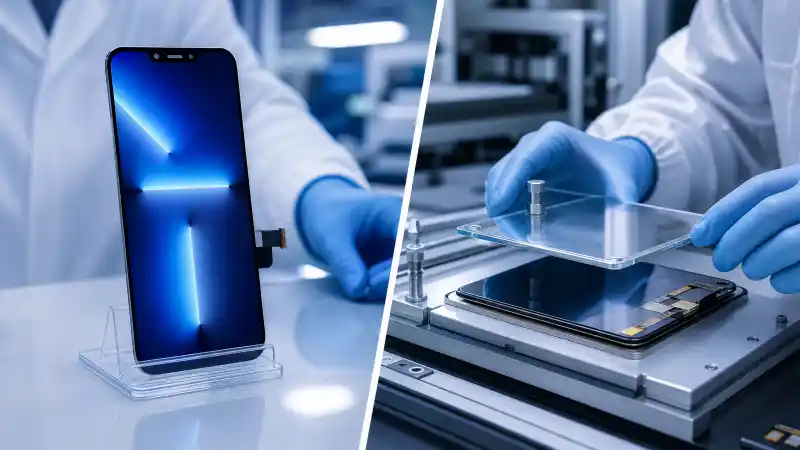
iPhone OLED screens are primarily divided into two types: Hard OLED and Soft OLED. They have significant differences in structure, performance, and cost.
| Comparison Item | Hard OLED | Soft OLED |
|---|---|---|
| Drop Resistance | Fragile (Not drop-resistant) | Durable (Drop-resistant) |
| Touch Feel | Harder | Softer |
| Material | Protected by a layer of transparent resin material | Encapsulated using a polymer cover glass combined with a special film |
| Special Features | None | Unique bending and folding characteristics |
| Price | Lower | Higher |
| Weight | Lighter | Even lighter |
| Thickness | Slightly thicker | Thinner |
| Display Area | Slightly smaller than Soft OLED | Larger, closer to the original display |
| Representative Brands | GX, GX-2, ZY, JK | HX, RJ, DD, JK |
Hard OLEDs typically use a glass substrate, which is more cost-effective but has poor drop resistance due to its rigid structure. The display area might be slightly smaller than the original. Soft OLEDs, on the other hand, use a flexible substrate, offering better drop resistance and bending characteristics. The display area is larger, providing a visual experience closer to the original screen, but the cost is relatively higher
Quality Differences in iPhone Incell Screens
Incell screen technology integrates the touch layer inside the liquid crystal layer, commonly used in LCD screens. In the iPhone repair market, Incell screens are also categorized into different tiers based on their resolution, quality grade, and packaging process
| Resolution | Quality Grade | Packaging Process | Core Difference Description | Corresponding Brands |
|---|---|---|---|---|
| FHD | AAA | COF / COG | FHD Glass | ZY, RJ |
| FHD | AA | COG | Uses HD+ glass, FHD materials for backlight and polarizer, with color performance close to FHD | ZY, JK |
| HD+ | — | COG | Equipped with brightness enhancement film | ZY, GX, JK, MOSHI |
| HD | — | COG | Without brightness enhancement film | HL, PK, GX-2 |
Quality Grade Ranking: FHD AAA > FHD AA > HD+ > HD > Small Q .
COF (Chip On Flex) and COG (Chip On Glass) are two common driver IC packaging processes :
• COG: The driver IC is bonded directly onto the liquid crystal glass body.
• COF: The driver IC is bonded onto the FPC (Flexible Printed Circuit).
The display area of COF is generally larger than that of COG, making COF screens visually closer to a full-screen effect
Sourcing Advice for Different Business Types
Based on the product quality characteristics mentioned above, here is advice for sourcing spare parts from China, tailored to different types of mobile phone parts businesses, such as repair chain stores, screen wholesale distributors, online parts stores, and phone refurbishment centers:
• Repair Chain Stores: Focus on repair efficiency and customer satisfaction. It is recommended to source Soft OLED and FHD AAA/AA grade Incell screens, which offer stable quality, good compatibility, and comprehensive after-sales service. For models requiring IC transplantation like the iPhone 11, ensure the supplier can provide high-quality IC chips or screens that support IC transplantation. Additionally, consider purchasing diagnostic equipment to handle various repair needs.
• Mobile Phone Screen Wholesale Distributors: Need to meet diverse market demands. It is advisable to build a comprehensive product line covering Hard OLED, Soft OLED, and various quality grades of Incell screens to accommodate different customer budgets and quality requirements. Establish long-term partnerships with suppliers to ensure stable supply and competitive pricing.
• Online Mobile Phone Repair Parts Stores: Emphasize cost-effectiveness and accurate product descriptions. It is recommended to clearly label the quality grade of the products (e.g., Hard OLED, Soft OLED, Incell FHD AAA) and provide clear product images and performance parameters. Sourcing can focus on highly cost-effective Hard OLED and Incell HD/HD+ grade screens, while also stocking a small number of high-end products to meet specific customer needs.
• Mobile Phone Refurbishment Centers: Pursue cost-efficiency and the quality of the refurbished product. It is recommended to source Hard OLED and Incell HD/HD+ grade screens with stable quality and moderate prices. For models requiring IC transplantation, ensure the sourced screens can undergo smooth IC transplantation and eliminate warnings via diagnostics. Attention should also be paid to sourcing other accessories like batteries and charging cables to provide a complete refurbishment solution.
Business Characteristics and Advantages of Arielk
Arielk is a Chinese mobile phone spare parts export wholesale supplier with over 20 years of experience, dedicated to providing high-quality products and services to global customers. Its business characteristics and advantages include:
• Rich Industry Experience: Over 20 years of deep cultivation in the industry has accumulated profound professional knowledge and market insight, enabling accurate grasping of industry trends and customer needs.
• Comprehensive Product Categories: Offers a full range of products including mobile phone screens for major brands, batteries, charging cables, chargers, phone cases, Bluetooth earphones, mobile phone repair machines and tools, and tempered glass protectors, meeting customers' one-stop sourcing needs.
• Multi-Channel Shipping Options: Provides flexible and diverse shipping options to ensure goods are delivered safely, efficiently, and on time to all parts of the world.
• Flexible and Secure Payment Methods: Supports multiple payment methods and accepts local currency payments in most regions, greatly facilitating transactions for international customers.
• Quality Assurance: A strict quality control system ensures all products meet high standards, providing customers with reliable quality guarantees.
• Perfect After-Sales Service: A professional after-sales team provides timely and effective technical support and solutions, relieving customers of any worries.
These significant advantages are exactly why foreign importers choose to establish long-term, stable partnerships with Arielk.
Moving Forward Together, Creating Brilliance
In today's increasingly competitive global mobile phone repair parts market, choosing a reliable and professional supplier is the key to success. With its outstanding product quality, rich categories, flexible services, and profound industry experience, Arielk is undoubtedly your ideal strategic partner.
We sincerely call upon all types of foreign wholesale enterprises with mobile phone repair parts business needs, especially large chain stores and wholesalers, to establish a strategic partnership with Arielk. By moving forward together with Arielk, you will gain:
• Stable, High-Quality Supply: Ensure your business has a continuous and reliable supply of premium spare parts.
• Competitive Pricing: Enjoy the cost advantages brought by scale procurement, enhancing your market competitiveness.
• Comprehensive Product Support: From screens to tools, a one-stop solution for all your sourcing needs.
• Professional Service Guarantee: From logistics to after-sales, a worry-free cooperation experience throughout the entire process.
Choosing Arielk means choosing to walk with professionals and partnering with success. Let us seize market opportunities together and create a brilliant future for the mobile phone repair parts industry!