Wholesale Cell Phone Parts for Latin America: Mixed MOQs & Flexible Payments
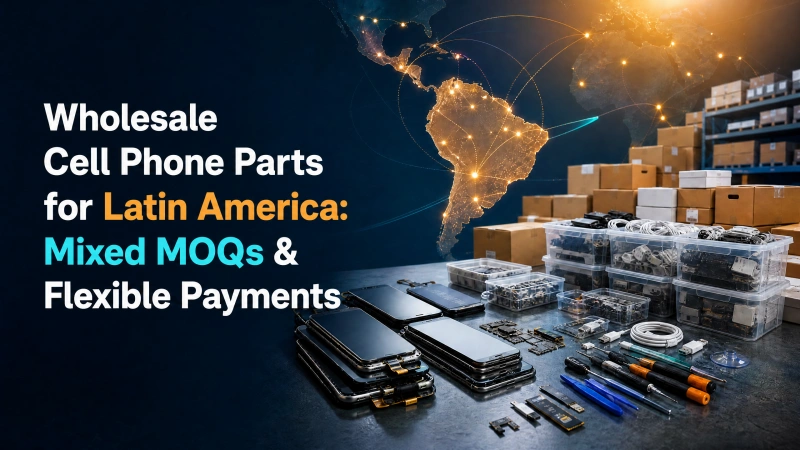
For phone repair chains and wholesale distributors in Peru, Colombia, Chile, Ecuador, and other Latin American markets, supply-chain management is a constant balancing act. Businesses must keep enough replacement parts available to serve customers quickly, while avoiding excessive inventory that ties up cash, becomes obsolete, or is difficult to resell.
The challenge becomes more complex when buyers source parts for many brands and models at the same time. A typical distributor may need iPhone screens, Samsung displays, Xiaomi batteries, Oppo charging ports, Vivo cables, and Honor components in a single purchasing cycle. If each product category comes from a different supplier, the result can be higher freight costs, more paperwork, inconsistent quality, and multiple payment procedures.
Currency volatility, local tax considerations, banking restrictions, and long international shipping cycles can further increase operational friction. For Latin American repair businesses, the best supplier is therefore not simply the one offering the lowest unit price. It is the partner that helps reduce total procurement risk while making cash flow, inventory planning, and replenishment easier to control.
ARI Electronics addresses these bottlenecks through flexible payment channels, broad model coverage, low mixed minimum order quantities, and one-stop export support.
Why Cash Flow and Inventory Are Closely Connected
Cash flow and inventory should not be managed as separate issues. Every product sitting on a warehouse shelf represents invested capital. When a repair shop or distributor purchases too many slow-moving parts, the business may have less cash available for rent, labor, marketing, emergency replenishment, or new high-demand models.
At the same time, carrying too little stock creates a different risk. If a frequently requested screen or battery is unavailable, technicians may be unable to complete repairs, customers may move to competitors, and distributors may lose sales opportunities. The goal is not to maximize inventory. The goal is to maintain the right inventory mix at the lowest practical procurement cost.
| Operational pressure | Common consequence | Better supply-chain response |
| Many brands and models | Capital is spread across too many individual SKUs | Consolidate purchases through a full-model supplier |
| High minimum order quantities | Slow-moving parts accumulate | Use mixed SKU ordering and lower MOQs |
| Multiple overseas suppliers | More freight, invoices, and quality checks | Build a one-stop purchasing plan |
| Currency and payment restrictions | Delayed settlements and uncertain landed cost | Use suitable multi-channel payment options |
| Long replenishment cycles | Stockouts interrupt repairs | Combine fast-moving and backup inventory in planned batches |
| Model turnover | Older components become harder to sell | Purchase in smaller, more flexible mixed lots |
A supplier that can support both purchasing flexibility and product breadth gives buyers more control over this balance.
1. Break the Payment Barrier: Flexible Multi-Channel Solutions
Foreign-exchange controls and international payment procedures should not paralyze a repair-parts supply chain. For many Latin American buyers, the payment route is an important part of the purchasing decision because the wrong method can create delays, additional banking charges, or unnecessary administrative complexity.
ARI supports local businesses with versatile payment methods designed to make cross-border purchasing more practical. Depending on the buyer’s internal procedures and transaction requirements, available options may include secure Miami offshore USD accounts, international wire transfers, commonly known as T/T, and reliable third-party multi-currency escrow arrangements.
The value of multi-channel payments is not merely convenience. It gives distributors and repair chains the ability to select a settlement method that fits their banking structure, accounting process, and purchasing schedule. When payment confirmation is clear and funds can be received efficiently, suppliers can prepare goods sooner and buyers can plan shipping with greater confidence.
Miami Offshore USD Accounts for International Procurement
A Miami offshore USD account can be a practical option for businesses that manage international purchasing in U.S. dollars. It may simplify the settlement process for buyers whose domestic banking environment makes direct foreign payments slower or more complicated. It can also help align supplier invoices, payment records, and export documentation within a familiar international currency.
Buyers should always confirm the account details, beneficiary information, transaction limits, and compliance requirements before sending funds. ARI’s role is to provide a clear payment process and responsive communication so that the order does not stall between quotation, payment confirmation, and shipment preparation.
International T/T Bank Transfers
International T/T transfers remain a standard choice for established importers and wholesale distributors. They provide a formal banking record and can be integrated into a company’s existing procurement and accounting procedures. For larger orders, recurring buyers may prefer T/T because it supports structured purchase orders, deposits, balance payments, and shipment documentation.
The key to a smooth T/T process is accuracy. The buyer and supplier should confirm the proforma invoice, beneficiary name, bank information, payment currency, deposit percentage, balance terms, and remittance reference before the transfer is initiated. A well-organized supplier helps reduce the risk of mismatched information and avoidable payment delays.
Third-Party Multi-Currency Escrow Accounts
For new relationships or transactions involving several currencies, third-party multi-currency escrow accounts can provide an additional layer of transaction coordination. Escrow arrangements may be useful when the buyer wants payment to be held and released according to agreed conditions, such as order confirmation, inspection, or shipping documentation.
The exact terms depend on the selected service provider and the commercial agreement between the parties. Buyers should review all fees, release conditions, verification procedures, and refund rules before using an escrow service. The purpose is to create a more transparent transaction workflow, not to replace proper due diligence.
How Payment Flexibility Improves Working Capital
Flexible payment channels can help businesses manage the timing of procurement more carefully. Instead of delaying a replenishment order because one payment route is unavailable, the buyer can discuss a suitable alternative with the supplier. This is especially valuable when a repair chain needs to restock high-demand screens or batteries before a seasonal sales period or a large customer order.
ARI also encourages buyers to treat payment terms as part of the total supply-chain plan. The best purchasing decision considers not only the quoted unit price, but also payment speed, bank fees, documentation, shipment readiness, and the cost of waiting for stock.
2. Zero Inventory Deadstock: Full-Model Coverage and Mixed SKU Wholesaling
Latin American phone markets include a broad combination of premium, mid-range, and entry-level devices. iPhone and Samsung models may generate strong demand in some channels, while Xiaomi, Oppo, Vivo, and Honor products can be essential to other repair shops and regional distributors. A wholesaler that carries only one brand or a narrow model range may force customers to buy the remainder of their order elsewhere.
ARI reduces this fragmentation by offering one-stop access to a wide range of phone replacement parts. The product mix can include replacement screens, batteries, charging cables, charging ports, flex cables, housings, camera components, speakers, buttons, and other repair consumables, subject to availability and model requirements.
The Advantage of Mixed SKU Ordering
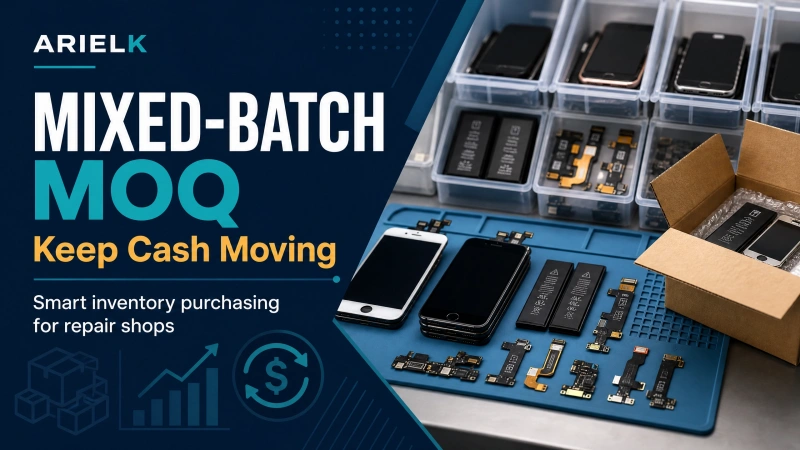
The most important benefit for many Latin American buyers is the ability to combine different products and models in one shipment. A distributor does not need to purchase a full carton of every individual SKU simply to access wholesale pricing. Instead, a single pallet can include screens, high-capacity batteries, and charging cables for dozens of phone models.
This approach is particularly useful for businesses serving multiple repair locations or reselling to independent technicians. Demand is rarely identical across every city, neighborhood, or customer segment. Mixed SKU purchasing allows the buyer to create a more realistic inventory portfolio based on actual repair patterns rather than supplier-imposed carton quantities.
| Mixed shipment category | Example purchasing objective |
| Screens and displays | Cover high-frequency repairs across iPhone, Samsung, Xiaomi, and other brands |
| Batteries | Add replacement capacity for popular and aging device models |
| Charging cables | Increase order value with compact, regularly consumed accessories |
| Charging ports and flex cables | Support technicians who handle board-level and component-level repairs |
| Small repair parts | Fill gaps in local inventory without creating large deadstock positions |
Lower MOQs Reduce Deadstock Risk
A high MOQ can appear attractive because it may lower the unit cost, but it can also force a buyer to hold more stock than the market can absorb. This is a serious concern for model-specific components. When consumer preferences change or a device becomes less common, excess screens and batteries may remain in storage for too long.
Low mixed MOQs provide a more flexible alternative. Buyers can test demand, replenish proven models, and add new SKUs gradually. This makes it easier to serve a broad customer base without committing too much working capital to every individual product.
For a phone screen bulk supplier in Peru, flexibility is especially important when the customer base includes both popular local models and occasional repair requests for less common devices. For a cell phone battery supplier in Colombia, mixed purchasing can help distributors combine high-volume batteries with smaller quantities for regional or specialized demand.
One Shipment, Better Freight Efficiency
Consolidating products into one shipment can simplify logistics and improve freight efficiency. Instead of receiving several small shipments from different vendors, a buyer can coordinate a consolidated order with one supplier, one packing list, and one main communication channel.
Freight efficiency depends on the final product dimensions, weight, packaging method, route, shipping mode, and destination. However, the principle is straightforward: combining compatible products allows buyers to make better use of available shipping capacity. It can also reduce the time spent tracking multiple consignments and resolving separate delivery issues.
ARI can help buyers organize mixed orders according to model, product type, and shipment requirements. Before production or packing begins, the buyer should confirm the final SKU list, quantities, packaging specifications, labels, and shipping documents.
3. Build a Smarter Inventory Portfolio for Local Demand
Mixed SKU purchasing works best when it is supported by a clear inventory strategy. Buyers should divide products into several practical groups rather than treating every SKU in the same way.
Core fast-moving SKUs are the models that generate regular repair demand. These products deserve the highest replenishment priority and may be ordered in larger quantities. Support SKUs are parts that sell steadily but at a lower rate, such as batteries or cables for older devices. Long-tail SKUs are less predictable products that should generally be purchased in smaller quantities or only when customers place confirmed requests.
A simple inventory review can use the following questions:
- Which models were repaired most frequently during the last purchasing cycle?
- Which parts caused lost sales because they were unavailable?
- Which products have remained in storage longer than expected?
- Which models are requested across more than one store or customer account?
- Can several product categories be consolidated into the next shipment?
This review helps the buyer shift capital away from inactive inventory and toward parts with stronger turnover potential. It also creates a more useful discussion with the supplier because the next order is based on evidence rather than guesswork.
4. Use Quality Control to Protect Cash Flow
Low prices do not create value if a high defect rate leads to returns, rework, shipping disputes, or technician downtime. Quality control is therefore part of inventory optimization. Every defective screen or unreliable battery can consume additional labor and reduce the profitability of the original sale.
Before placing a larger order, buyers should clarify product specifications, compatible models, grade or quality level, warranty terms, testing procedures, packaging, and labeling. For screens, the discussion may include display technology, frame options, touch performance, brightness, and whether the component is supplied with additional parts. For batteries, buyers may need to confirm capacity specifications, safety labeling, connector compatibility, and production information.
A professional supplier should be able to communicate quality standards clearly and support an agreed inspection process. Buyers may also request sample evaluation before scaling up a mixed SKU program. This approach helps verify compatibility and gives technicians an opportunity to assess installation performance.
5. Make Replenishment More Predictable
A reliable wholesale relationship should make the next order easier than the first one. After each shipment, buyers can record actual sales, installation feedback, damaged units, customer requests, and remaining stock by SKU. This information can be used to create a replenishment list for ARI.
The list does not need to be complicated. A practical format includes the model, part type, current stock, estimated monthly usage, desired safety stock, and requested quantity. When this data is shared consistently, the supplier can understand which items should be packed together and which products should remain at a lower quantity.
| SKU planning field | Why it matters |
| Phone brand and model | Prevents compatibility mistakes |
| Part category | Separates screens, batteries, cables, and other components |
| Current stock | Shows the immediate replenishment gap |
| Recent usage | Indicates actual demand rather than assumptions |
| Safety stock target | Protects against unexpected repair volume |
| Requested quantity | Creates a clear purchase-order starting point |
| Quality or grade requirement | Aligns product expectations before production or packing |
This process turns one-time wholesale purchasing into a repeatable supply program.
6. Why ARI Electronics Is a Practical Partner for LatAm Buyers
ARI Electronics is positioned to support repair businesses and distributors that need a broad product range without the complexity of managing many separate suppliers. Its value proposition is built around four operational priorities: product coverage, mixed SKU flexibility, payment choice, and shipment consolidation.
For a buyer, this means the purchasing conversation can cover the complete requirement instead of focusing on only one product category. The same order may include phone screens for a repair chain, batteries for a regional distributor, and charging accessories for retail resale. Combining these needs can make the order more commercially useful and reduce the pressure to meet a large MOQ for every individual model.
ARI’s approach is also suitable for businesses that want to expand their product range gradually. A buyer can begin with fast-moving models, evaluate quality and sales performance, and then add more Xiaomi, Samsung, iPhone, Oppo, Vivo, or Honor SKUs in later mixed orders.
A Practical Purchasing Workflow for Latin American Distributors
A structured order process helps both sides reduce errors. Begin by sharing the destination country, target brands, model list, part categories, estimated quantities, required quality level, and preferred shipping timeline. ARI can then prepare a quotation or proforma invoice based on the requested mix.
Next, review the details carefully. Confirm model compatibility, quantities, unit prices, packaging, payment method, lead time, warranty policy, shipping terms, and documentation. If the order includes batteries or other regulated goods, confirm the applicable packing and transport requirements before payment.
After payment is confirmed, maintain one approved SKU list. Any changes should be documented before packing begins. When the goods are ready, review the packing list and shipping information, then coordinate inspection or pre-shipment confirmation according to the agreed process.
This workflow creates accountability at every stage and helps prevent a small model-number error from becoming a costly inventory problem.
Optimize the Whole Order, Not Just the Unit Price
For Latin American phone repair businesses, sustainable growth depends on more than finding a low-cost component. Buyers need a supply partner that understands the relationship between cash flow, MOQ, product variety, freight, payment procedures, and repair demand.
ARI Electronics helps address these needs through full-model supply for major brands, low mixed MOQs, consolidated shipments, and multiple payment channels. Whether you are looking for a wholesale cell phone parts supplier in Latin America, a phone screen bulk supplier in Peru, a mixed SKU phone parts wholesaler, or a cell phone battery supplier in Colombia, a flexible purchasing model can help you reduce deadstock and keep more capital available for growth.
The practical next step is to prepare your model list and recent demand data. Share the brands, parts, quantities, destination, and preferred payment route with ARI Electronics to build a mixed order that fits your market and inventory strategy.
【Contact ARI Sales Team for The Lestes Price List】