Step-by-Step Guide to Testing Wholesale Mobile Phone Parts Before Shipment: A Comprehensive Quality Manual
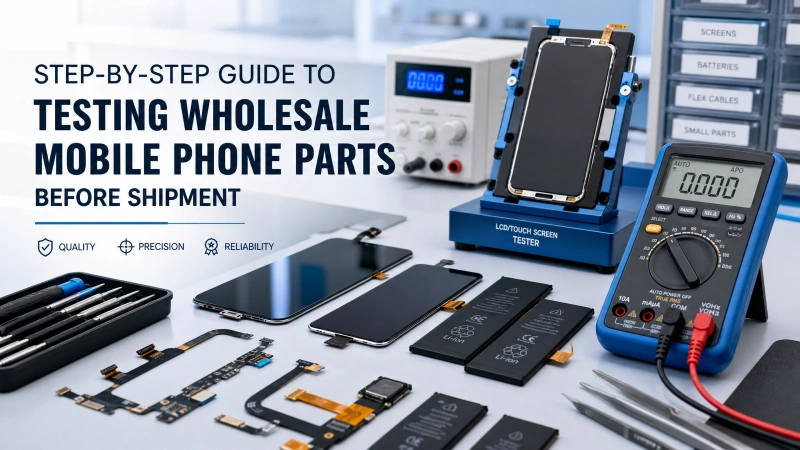
In the mobile phone parts wholesale industry, Quality Control (QC) is the lifeblood of a sustainable business. For wholesalers, implementing rigorous testing procedures before shipment is not just about reducing the Return Merchandise Authorization (RMA) rate; it is about building irreplaceable customer trust in a highly competitive market. This guide provides a detailed, step-by-step framework for testing mobile parts, from screens to the smallest flex cables.
Step 1: Visual and Cosmetic Inspection
Visual inspection serves as the first line of defense, designed to eliminate obvious physical defects before functional testing begins.
- Surface Integrity: Examine screens for scratches, cracks, or chipped edges. Inspect housings for deformities, dents, or uneven paint finishes.
- Solder Pads and Alignment: For flex cables and small electronic components, verify that solder joints are full and free of "cold solder" issues. Ensure that connectors are at the correct depth and perfectly aligned.
- Cleanliness: Confirm that camera lenses are free of internal dust and that display backlight layers show no fingerprints or smudges.
Pro Tip: Use a high-magnification loupe or a digital microscope to check for micro-cracks in flex cables, which are often the "silent killers" of part functionality post-installation.
Step 2: Display and Digitizer Functionality Testing
Screens are typically the highest-value and most fragile components in a wholesale order, necessitating a 100% inspection policy.
• Dead Pixel and Color Check: Cycle through solid Red, Green, Blue, Black, and White backgrounds to identify dead pixels, bright spots, or color bleeding.
• Touch Sensitivity: Use dedicated testing software or the "icon dragging" method to cover every square millimeter of the screen, ensuring there are no "dead zones."
• Backlight Consistency: Inspect the display at maximum brightness to check for light leakage around the edges or uneven luminance.
• Firmware Compatibility: For high-end models (e.g., iPhones), verify that the screen's IC chip successfully passes the system's firmware handshake to avoid "Important Display Message" pop-ups.
Step 3: Battery Performance and Safety Testing
Battery quality directly impacts end-user safety and device longevity. There is zero room for error in this category.
- Capacity Verification: Utilize battery capacity testers to confirm that the actual capacity meets at least 95% of the rated specification.
- Cycle Count and Health: Ensure that new batteries show a cycle count of 0 and a health status of 100% in diagnostic tools.
- Charging Stability: Monitor the temperature during rapid charging to ensure it remains within safe limits, ruling out internal short circuits.
- Voltage Retention: Let the battery sit for 24–48 hours and measure the voltage drop; it should remain within a negligible range.
Step 4: Small Parts and Functional Flex Cable Testing
While small, components like cameras, charging ports, and button flex cables are critical to the overall user experience.
| Component Category | Key Testing Points |
| Camera Modules | Autofocus speed, image clarity, and sensor spot checks. |
| Charging Port Flex | Current draw (Amps), data sync stability, and microphone clarity. |
| Ear/Loudspeakers | Sound clarity, volume levels, and absence of distortion or crackling. |
| Side Key Flex | Tactile feedback (clickiness), trigger sensitivity, and switch toggle smoothness. |
Step 5: Final QC and Protective Packaging
Once all functional tests are passed, the final packaging phase determines whether the parts arrive safely at the customer's doorstep.
• Anti-Static Protection: All electronic components must be placed in ESD (Electrostatic Discharge) bags.
• Cushioning: Fragile items like LCDs should be reinforced with multiple layers of bubble wrap or custom-fitted foam boxes.
• Label Verification: Double-check that product labels (model, variant, grade) match the invoice exactly to prevent shipping errors.
• Outbound Sampling: Before sealing the master carton, a QC supervisor should perform a random 5%–10% spot check as a final safety lock.
Partner with a Legend in the Industry
Quality is not just a process; it is a commitment built over decades. With over 20 years of specialized professional experience in the mobile phone parts wholesale industry, Arielk has established a legacy of excellence and reliability. We understand the nuances of quality control and the critical importance of every single component in your supply chain.
Why settle for uncertainty when you can leverage two decades of expertise? Whether you are looking to scale your business or secure a more reliable supply of premium parts, Arielk is your trusted partner for growth.
Ready to elevate your business standards? Join forces with Arielk today and experience the difference that true professional expertise makes.