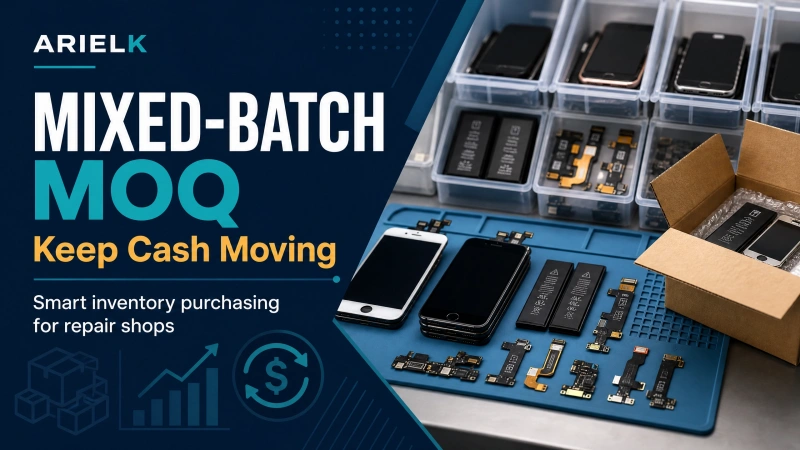
Why Mixed-Batch MOQ Matters to Repair Shops
For a mobile phone repair shop, the hardest part of purchasing is not simply finding a supplier. The real challenge is keeping commonly used parts in stock without tying too much cash up in slow-moving inventory.
Screens, batteries, charging ports, cameras, speakers, and flex cables are available in many models. Each model also has a different demand pattern. If every model must be purchased according to a separate minimum order quantity, or MOQ, a repair shop can quickly face two problems: popular parts sell out, while less popular parts remain in storage.
Mixed-batch MOQ offers a more flexible approach. It allows several models or compatible product categories to be combined in one purchasing batch, so a repair shop can cover more repair needs with a smaller initial investment.
Arielk has more than 20 years of experience in mobile phone parts wholesale and export. Based on our experience serving repair shops and overseas distributors, a well-planned mixed-batch order can do more than reduce the first purchase amount. It can turn purchasing from one-time stockpiling into a more flexible inventory management process.
What Problem Does Mixed-Batch MOQ Solve?
A traditional MOQ is often calculated by individual product or model. For example, a supplier may require 20 pieces per screen model or 50 pieces per battery model. These quantities may be manageable for a large distributor, but they can be excessive for a single repair shop or a small repair network.
With mixed-batch MOQ, a buyer may combine different models, colors, or product categories under agreed conditions. For example:
•Ten commonly used screen models may be purchased at two pieces per model to meet the total batch quantity.
•Different battery models may be combined to reach one overall MOQ.
•Screens, charging ports, and camera modules may be included in one order when they meet the supplier's agreed quality and packaging requirements.
The exact products that can be mixed must be confirmed with the supplier. Not every product can be combined freely because production, testing, packaging, and quality standards may differ. However, most repair shops can find a practical combination by planning their purchase list in advance.
From a cash flow management perspective, mixed-batch purchasing can reduce three types of pressure:
1.Lower initial investment per model. The shop does not need to purchase excessive quantities of a slow-moving model just to meet its individual MOQ.
2.Better inventory balance. The budget can be distributed across several products with real repair demand instead of being concentrated in a few SKUs.
3.Lower trial-order risk. New models or new quality grades can be tested in small quantities before the shop commits to a larger purchase.
Use Demand Segmentation to Build the Right Mixed Batch
Mixed-batch purchasing does not mean dividing the budget equally among all models. The first step is to classify SKUs according to actual repair records and sales data. Arielk recommends using at least three months of repair orders as a starting point.
A-Class: High-Frequency Repair Models
These models have stable demand and fast turnover. They should make up the main part of the order and should have an appropriate safety stock level.
For example, if a shop uses 12 pieces of a particular screen each month, it may begin with 8 to 12 pieces depending on supplier lead time and then replenish based on actual sales. Buying several months of stock simply to obtain a lower unit price may create unnecessary cash tied up in inventory.
B-Class: Steady but Limited-Demand Models
B-class models generate regular orders, but their monthly demand is relatively low. They are suitable for smaller quantities within a mixed batch. The goal is to maintain basic availability, not to build a deep stock position.
If a model is used only two or three times per month, there is usually no need to purchase dozens of pieces at once. Mixed-batch purchasing allows the repair shop to keep a small quantity available without putting too much money into stock.
C-Class: Low-Frequency or Uncertain Models
C-class models may be needed only once every few months, or they may be newly released models with limited historical data. These parts are better suited to order-based purchasing, limited trial quantities, or pre-order confirmation with the supplier.
The purpose of mixed-batch MOQ is not to stock every model. It is to use limited purchasing capital to cover the highest-probability demand first.
A Simple Way to Calculate Cash Tied Up in Inventory
A repair shop can estimate the cash invested in a particular SKU with this formula:
Inventory cash tied up = purchase price × current inventory quantity
To estimate how long the stock may last, use this formula:
Inventory coverage in months = current inventory quantity ÷ average monthly usage
Consider the following example for three screen models:
| Model | Unit purchase price | Average monthly usage | Traditional quantity | Mixed-batch quantity | Cash tied up after mixed-batch purchase |
| Model A | USD 35 | 8 pieces | 20 pieces | 8 pieces | USD 280 |
| Model B | USD 32 | 3 pieces | 20 pieces | 4 pieces | USD 128 |
| Model C | USD 28 | 1 piece | 20 pieces | 2 pieces | USD 56 |
| Total | 60 pieces | 14 pieces | USD 464 |
If each model had to be purchased separately at 20 pieces, the initial product cost would be:
35 × 20 + 32 × 20 + 28 × 20 = USD 1,900
With the mixed-batch approach, the first purchase includes 14 pieces and costs USD 464 before freight, packaging, and other charges. The initial cash requirement is therefore much lower.
This example does not represent a universal price or MOQ offered by every supplier. It illustrates a purchasing principle: test real demand with a smaller order first, then invest more in products with faster turnover.
Five Points to Confirm When Asking a Supplier for a Quote
Many purchasing problems arise because the buyer and supplier have different understandings of the term “mixed batch.” When requesting a quotation, a repair shop should clarify the following points.
1. Which Products Can Be Mixed?
Specify whether the order will combine models within one product category or combine several categories. Screens and batteries, for example, may need separate confirmation because their production, testing, and packaging processes can be different.
2. What Is the Minimum Quantity per Model?
Even when a supplier supports mixed-batch purchasing, each model may still have a minimum quantity. Confirm whether the requirement is one piece per model, five pieces per model, or another amount.
3. Is the Total MOQ Based on Quantity or Order Value?
Some suppliers calculate MOQ by total pieces, while others calculate it by total order value. These two methods lead to different purchasing strategies. If MOQ is value-based, higher-priced and lower-priced products can be combined to reach the target more efficiently.
4. What Are the Quality and Warranty Terms?
Confirm whether all items in the mixed batch belong to the same quality grade. The order may include original pulled parts, compatible replacement parts, or different grades of new parts. The testing period, defect-handling procedure, and acceptable quality standard should also be agreed in advance.
5. What Are the Lead Time, Packaging, and Shipping Conditions?
A smaller order does not always mean a lower total logistics cost. Compare the product price, packaging charge, freight, and landed cost. This prevents the repair shop from focusing only on unit price while overlooking the cost of receiving the goods.
Replace Large, Infrequent Purchases with Smaller, Regular Replenishment
Reducing cash tied up in inventory does not mean placing orders every few days. A more practical method is to establish a fixed replenishment schedule.
For each SKU, a repair shop can define three inventory levels:
•Safety stock: stock reserved for normal demand fluctuations and transport delays;
•Reorder point: the level at which the shop starts requesting a quote or placing a purchase order;
•Maximum stock level: a limit that prevents the shop from purchasing more inventory than it can reasonably use.
Suppose a battery model has average monthly usage of 10 pieces and a supplier lead time of approximately 15 days. The shop might set a reorder point of six to eight pieces and adjust its safety stock according to shipping reliability and demand volatility. These numbers should be based on actual data rather than copied from another repair shop.
When several SKUs reach their reorder points at the same time, they can be combined into one mixed-batch order. This reduces scattered purchasing without forcing the shop to buy products that are not yet needed.
Three Common Purchasing Mistakes
Mistake 1: Looking Only at Unit Price
Bulk purchasing may produce a lower unit price, but if the products take six months to sell, storage costs, damage risk, and the opportunity cost of the money may eliminate the apparent saving.
A better purchasing decision considers the landed cost, expected turnover time, and warranty risk. For a repair shop, a slightly higher unit price with faster turnover may be healthier than the lowest possible price.
Mistake 2: Adding Slow-Moving Models Just to Meet MOQ
If a model has no consistent demand, adding it simply to reach MOQ converts cash into stagnant inventory. The proper use of mixed-batch MOQ is to lower the purchasing barrier for less common models, not to make the repair shop accept unnecessary stock.
Mistake 3: Treating Trial Stock as Long-Term Stock
New suppliers, new quality grades, and newly released models all require validation. The purpose of a first order should be to confirm compatibility, display performance, charging performance, packaging, and after-sales response. It should not be to maximize order volume immediately.
Once the product passes testing, the repair shop can increase the quantity according to actual usage. This reduces the cost of making the wrong purchasing decision at the beginning.
Arielk's Practical Advice for Repair Shops
If you are preparing to use a mixed-batch MOQ program, follow this process:
1.Export the last three months of repair and stock-out records, then calculate average monthly usage for each model.
2.Divide SKUs into high-frequency, steady-demand, and low-frequency groups. Do not group them only according to the supplier's catalog.
3.Set a purchasing budget and reserve part of it for urgent repair demand.
4.Allocate most of the budget to high-frequency models, then add selected B-class and tested C-class products.
5.Ask the supplier to confirm the eligible mixed-batch range, minimum quantity per model, total MOQ, quality grade, lead time, and warranty terms in writing.
6.After receiving the first order, record actual usage and quality feedback. Use that information to adjust the next order.
At Arielk, we recommend treating mixed-batch MOQ as an inventory optimization tool, not merely as a price negotiation method. A suitable mixed-batch plan should meet three conditions: it reflects the repair shop's actual demand, controls the amount of cash invested in one order, and does not create unnecessary after-sales risk.
Start a Conversation with Arielk
Do not let slow-moving stock consume the cash you need for fast-moving repairs. With a properly designed mixed-batch MOQ plan, your repair shop can cover more commonly requested models while reducing trial-order and replenishment pressure.
With more than 20 years of experience in mobile phone parts wholesale and export, Arielk can review your model list, monthly usage, target quality grade, and purchasing budget to help identify a more suitable mixed-batch combination.
Send Arielk your model list or current purchasing requirements and tell us: Which models do you run out of most often? Are you more concerned about MOQ, excess inventory, or product quality? We will start from your actual needs and work with you toward a more reliable purchasing plan.
https://www.ari-elk.com/contact-us
Reference Note
This article presents purchasing recommendations based on Arielk's experience in Chinese mobile phone parts export and wholesale. The numerical example is for illustration only and does not constitute a commitment regarding specific prices, MOQs, shipping terms, or warranty conditions. Actual mixed-batch rules should be confirmed according to the products, order quantities, quotation, and terms agreed by both parties.