For mobile phone repair chains, spare-parts wholesalers and cross-border sellers, battery purchasing should involve more than comparing prices and printed capacity. Two batteries marked 4,000 mAh may differ significantly in actual discharge capacity, internal resistance, cycle degradation, protection-board performance and after-sales reliability.
The real cost of a battery order includes more than the purchase price. Rework, customer returns, shipping delays, marketplace claims and damage to your reputation can quickly eliminate the savings from a lower quotation. That is why capacity, cycle life and RMA handling should be evaluated as one quality-management system before a bulk order is placed.
Confirm What “Capacity” Really Means
Battery capacity is usually expressed in mAh. It describes how much charge a battery can deliver under defined test conditions. It is not an absolute number that can be compared without considering voltage and the measurement method.
When comparing products from different suppliers, confirm the following points:
•Rated capacity versus typical capacity: Is the supplier quoting a rated value, a typical value or a guaranteed minimum? A typical capacity should not automatically be treated as the minimum capacity required for every delivered unit.
•Test conditions: Ask for the charging method, rest time, discharge current, cut-off voltage and test temperature. IEC 61960 covers secondary lithium cells and batteries for portable applications and includes discharge-performance evaluation under defined conditions. Changes in discharge current or cut-off voltage can affect the measured result.
•Voltage and energy: When two products have different voltages, comparing mAh alone can be misleading. Where relevant, compare Wh as well, since energy reflects both voltage and capacity.
•Capacity consistency: Do not evaluate a batch only by its average result. The variation between samples is also important. A few high-performing samples can hide a large number of low-capacity units.
How to verify capacity before ordering
Ask the supplier for a complete specification sheet and the exact sample-test conditions. Select samples randomly from the same production batch and test them with calibrated charge-discharge equipment. Record the sample number, initial voltage, measured capacity, internal resistance and test temperature.
The acceptance requirement should be written into the purchase order or quality agreement. For example: “Under the agreed test conditions, measured capacity shall not be below the specified minimum.” Phrases such as “sufficient capacity” or “same as original” are too vague to resolve a dispute effectively.
Evaluate Cycle Life by Its Test Definition, Not by a Single Number
Cycle life is the number of charge-discharge cycles a battery can complete under specified conditions before reaching a defined capacity-retention threshold. It is not a fixed number that applies equally to every use case.
Temperature, charge and discharge rates, charging cut-off conditions, depth of discharge and long-term storage can all affect capacity degradation. The University of Maryland’s CALCE battery testing data combines temperature, charge/discharge rates and cut-off conditions to study capacity fade and assess whether a battery can meet its life-cycle requirements.
When a supplier claims “500 cycles” or “800 cycles,” ask at least these four questions:
1.What are the charge and discharge conditions? Confirm the charge rate, discharge rate, charge cut-off voltage and discharge cut-off voltage.
2.What is the test temperature? A room-temperature test and an accelerated high-temperature test should not be treated as direct evidence of the same real-world service life.
3.What is the end-of-life definition? Is it 80% of initial capacity, or another retention threshold? The endpoint must be clearly stated.
4.How many samples were tested? The best result from one cell does not represent the stability of a bulk shipment.
For wholesale purchasing, cycle life is best used as a product-grade and application-screening criterion. A battery for a standard repair channel, a heavily used refurbished phone and a commercial device with high runtime expectations may require different capacity floors, cycle-life targets and price levels.
Instead of pursuing the highest advertised cycle number, define the expected customer usage period first. Then select a product grade that matches your sales channel, margin and after-sales risk.
Choose Quality Grades by Measurable Criteria
Suppliers may describe batteries as Grade A, Premium, High Capacity or similar terms. These labels are not sufficient evidence unless they are linked to written and verifiable specifications.
Break the product grade into measurable areas:
•Cell source and batch information: Is there a batch number, production date and receiving record? Can different production batches be mixed in one order?
•Electrical performance: Check measured capacity, open-circuit voltage, internal resistance, charge-discharge behavior and protection-board function.
•Construction and appearance: Verify dimensions, thickness, cable or connector position, insulation, labels and packaging against the target phone model.
•Safety and shipping documentation: Can the supplier provide a UN 38.3 test summary that matches the actual battery model and configuration, along with other documents required for the destination and transport method?
•Batch consistency: Confirm whether the order will use the same specification, cell design and reasonably similar production batches.
For international shipments, “fits the phone” is not enough. The U.S. Pipeline and Hazardous Materials Safety Administration states that lithium batteries must undergo the design tests in Sub-section 38.3 of the United Nations Manual of Tests and Criteria, and it provides guidance on lithium battery test-summary requirements.
Buyers should verify that the test summary matches the actual model, configuration and revision. A generic document that cannot be linked to the shipped product does not provide the same level of assurance.
Use a Three-Level Incoming Inspection Process
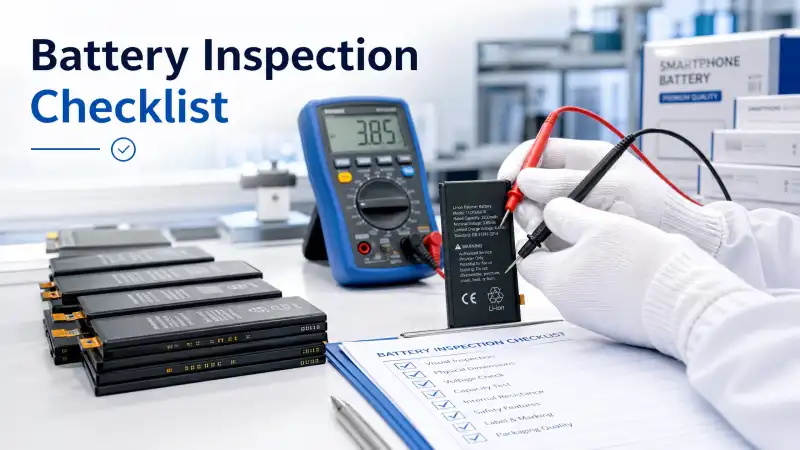
Level one is document and visual inspection. Check the model, labels, quantity, packaging, batch information, production date and shipping documents. Look for swelling, damage, leakage, dents, deformed connectors, exposed conductors or damaged insulation. Any product showing an obvious safety risk should be isolated and handled according to an appropriate safety procedure rather than immediately connected to test equipment.
Level two is basic electrical inspection. Use suitable equipment to test open-circuit voltage, internal resistance and capacity. Capacity testing should follow the conditions agreed by both parties, and the original data should be retained. When testing batteries in phones, also check recognition, charging, discharging, temperature rise and protection behavior. Capacity alone is not a complete quality assessment.
Level three is a small-scale market or field validation. For a first order, a new cell design or a new phone model, begin with a controlled quantity. Review installation results, customer feedback and early failure data before committing the full purchasing budget to an unvalidated specification.
The inspection plan should also be agreed in advance. Define the sample size, acceptance criteria, reinspection rules, full-batch rejection conditions and responsibility for testing costs. For higher-risk projects, an independent laboratory can witness or perform the test to reduce disputes caused by different equipment and procedures.
Define RMA Terms Before a Problem Occurs
RMA, or Return Material Authorization, is the process used to manage suspected quality problems and returned products. A structured RMA process normally covers the customer’s report, return authorization, failure-mode evaluation, warranty eligibility and a final disposition such as replacement, repair, credit or refund.
The Montana Photonics & Quantum Alliance explains that returned products are evaluated for failure mode, warranty eligibility and disposition such as rework or repair. RMA data can also provide insight into product reliability and customer satisfaction.
Your purchase agreement or quality agreement should define at least the following:
•Warranty start date: Does the warranty begin at shipment, delivery, installation or the end-customer sale?
•Coverage: Does it include insufficient capacity, failure to charge, abnormal battery drain, protection-board failure, swelling and cosmetic defects? Which cases are excluded as installation errors or customer damage?
•RMA evidence: What photos, videos, test data, error codes, purchase records and batch information are required?
•Quality metrics: Will performance be measured by DOA rate, early failure rate, return rate or total defect rate? Define the denominator and reporting period.
•Response time: How quickly must the supplier acknowledge a complete claim and provide a preliminary analysis and solution?
•Remedy: When will the solution be replacement, reshipment, credit, refund or a deduction from the next order?
•Logistics and damaged batteries: The return method and cost allocation for suspected damaged or swollen batteries must comply with applicable safety and transport requirements.
•Batch traceability: Keep purchase orders, carton labels, sample data and installation records so that a field failure can be linked to a specific batch.
If the RMA rate rises, do not limit the response to one-for-one replacement. Analyze the data by phone model, batch, supplier, cell design and failure mode. This helps distinguish isolated cases from a systematic batch problem.
RMA becomes a tool for reducing long-term business risk only when after-sales data is fed back into supplier selection, inspection and purchasing decisions.
6. Final Pre-Purchase Checklist
Build a Stable Supply Partnership with ARIELK
With 20 years of experience in mobile phone accessories wholesale and export, arielk understands that a reliable battery supply is about more than a competitive quotation. It also requires clear specifications, practical inspection arrangements, responsive communication and a workable approach to cross-border after-sales issues.
If you are sourcing mobile phone batteries for a wholesale channel, repair network, refurbished-device business or e-commerce market, contact the arielk sales team with your target models, order quantity, capacity requirements, quality grade, destination and warranty expectations. We can discuss the appropriate specifications, sample validation, bulk inspection and RMA arrangements for your business, helping you build a transparent, stable and long-term trading relationship.
https://www.ari-elk.com/contact-us