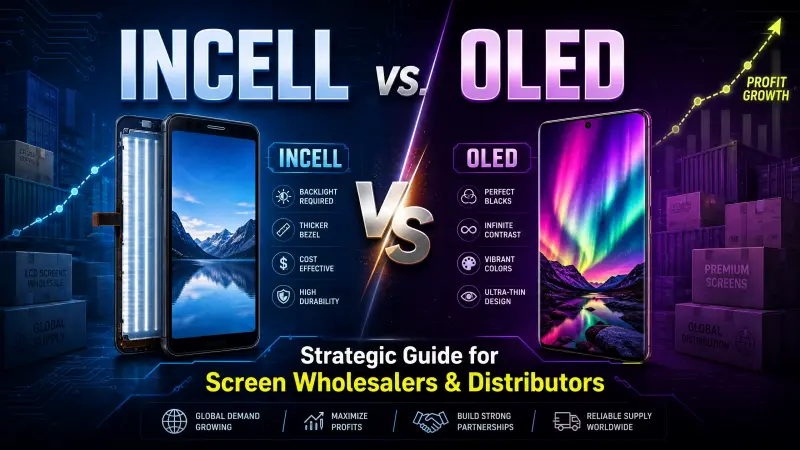
In the global mobile phone parts wholesale market, Incell LCD and OLED remain the two primary pillars of any distributor's inventory. For overseas wholesalers and regional distributors, choosing between these two screen types goes far beyond a simple comparison of "price vs. display quality."
Instead, it is a strategic balancing act that directly impacts your cash flow efficiency, cross-border RMA (Return Merchandise Authorization) costs, and B2B customer retention rates.
This guide provides an in-depth analysis of the core differences between Incell LCD and OLED, specifically from the perspective of an overseas screen distributor.
Market Positioning: "Essential Demand" vs. "Premium Upgrade"
Driven by global economic shifts and extended smartphone replacement cycles, the overseas refurbished and repair market has split into two distinct segments:
- Incell LCD (The Defensive Market Asset): By integrating the touch layer directly into the liquid crystal pixels, Incell achieves a thickness close to the original screen while maintaining a remarkably low production cost. It is the absolute go-to choice for price-sensitive end users, insurance repair contracts, and budget-friendly refurbishment factories.
- OLED (The Premium & Reputation Driver): Divided into Hard OLED and Flexible OLED. As the original factory technology for high-end flagship devices (such as iPhone 12–16 series and Samsung S-series), it is a non-negotiable requirement for franchised repair chains and premium refurbishers who refuse to compromise on quality.
Core Pain Points for Wholesalers: Incell vs. OLED
When evaluating your supply chain options, these four operational dimensions will directly dictate your net profit margins:
Capital Efficiency & Overseas Warehouse Pressure
- Incell LCD: Price is the ultimate weapon here. The wholesale cost of an Incell screen is typically only 25% to 30% of its OLED counterpart. This allows distributors to build a massive safety stock with a lower budget, significantly reducing the risk of capital ties-ups in overseas fulfillment centers (e.g., US/EU warehouses).
- OLED: High per-unit value means heavy capital commitment. Flexible OLEDs, in particular, carry steep purchasing costs. If market demand fluctuates or a new phone model drops, the financial risk of price depreciation and dead stock is substantially higher than with Incell.
Cross-Border Return Costs (RMA Rate & Reverse Logistics)
For overseas wholesalers, international return logistics and time delays are a major profit drain.
- Incell Risks: Due to intense price wars, low-end Incell screens often suffer from backlight bleeding, excessive thickness causing frame separation, and touch blind spots. Selecting the wrong supplier can push your RMA rate up to 5%–8%, completely wiping out your margins.
- OLED Risks: Generally offers more stable performance. However, Hard OLED is fragile and prone to cracking or developing green lines during installation or transit. Flexible OLED offers excellent durability but demands premium packaging and strict handling protocols.
Supply Chain Transparency & Aftermarket Brands
Overseas repair shops are highly brand-conscious when sourcing parts.
- In the OLED sector, a mature landscape of premium third-party aftermarket brands has emerged (such as GX, Hex, JK, FOG, etc.). Partnering with these recognized brands provides instant credibility and lowers the barrier of trust for your B2B buyers.
- Conversely, the Incell market consists largely of unbranded or white-label products. This heavily tests a distributor's direct quality control and sourcing capabilities at the factory level.
Technical Differences & B2B Communication Points
To help your sales team handle inquiries and better pitch to local repair shops, we have summarized the technical variances alongside common B2B customer complaints:
| Performance Metric | Incell LCD | OLED (Flexible/Hard) | Common Repair Shop Complaints |
|---|---|---|---|
| Chin Border / Bezel Width | The bottom bezel is slightly wider by 0.5–1mm compared to original OLED. | Matches the original factory dimensions perfectly. | End consumers complain that "the screen looks smaller" or "the borders look thick." |
| Color & Contrast | Blacks look slightly grayish; maximum brightness is lower. | Self-lit pixels deliver true blacks and vibrant color saturation. | Users used to OLED will notice an immediate visual downgrade when switching to Incell. |
| Power Consumption | Constant backlight requirement increases power draw by 15–20%. | Highly energy-efficient due to independent pixel illumination. | End users return to the shop complaining that "the battery drains much faster after the repair." |
| Thickness & Fitting | Thicker than OLED despite being an integrated Incell structure. | Extremely thin profile ensures a seamless flush fit with the mid-frame. | Poorly manufactured Incell brackets can result in noticeable gaps post-installation. |
Smart Sourcing & Inventory Strategies for 2026
How should overseas wholesalers optimize their inventory structure to maximize profitability in the current market?
1. Model-Based Segmentation
- iPhone 11 and Older Models: Push Incell LCD aggressively. These devices have lower residual value. Consumers are rarely willing to pay premium prices for an OLED repair, making Incell the ultimate high-volume profit driver.
- iPhone 12 / 13 / 14 Series: Implement a dual-track strategy. Adjust your ratios depending on your regional demographics (e.g., Western Europe/North America lean toward OLED, while Latin America/Middle East lean toward Incell). A balanced target ratio of 40% Incell (for volume) + 60% OLED (for high absolute profit) is highly recommended.
- iPhone 15 and Newer / High-End Flagships: Stick strictly to Flexible OLED. High-end smartphone owners are extremely meticulous about screen quality. Offering Incell for these models can severely damage your reputation as a premium wholesaler.
2. Build a "100% Tested" Brand Identity
Repair shops despise nothing more than a D.O.A. (Dead on Arrival) defect discovered after they have already disassembled a phone. Wholesalers should conduct 100% rigorous testing for touch responsiveness, dead pixels, backlight uniformity, and 3D touch prior to shipping. Seal your products with custom QC warranty labels to hedge against Incell quality variances.
3. Educate Your B2B Buyers on "Menu-Pricing"
Empower your repair shop clients by teaching them how to offer tiered pricing to their walk-in customers: an "Economy Plan (Incell)" and a "Premium Plan (OLED)". When repair shops learn how to retain low-budget customers with Incell while securing high-end profits with OLED, their purchasing volume and loyalty to your wholesale business will naturally multiply.
For overseas wholesale distributors, Incell LCD is not a competitor to OLED; rather, it is your most effective tool for optimizing cash flow and capturing the high-volume lower tier of the market. While OLED safeguards your technological edge and secures premium profit margins, Incell provides the steady volume and cash flow stability needed to thrive in a shifting economic landscape. Managing the quality control of both streams tightly is your ultimate competitive advantage in the cross-border phone parts industry.